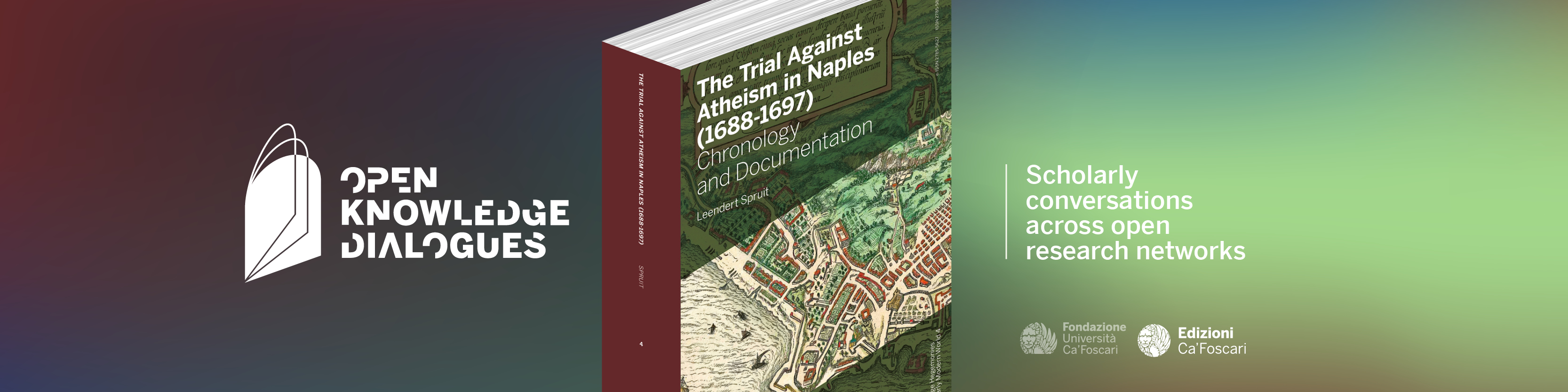
The next meeting of Open Knowledge Dialogues will take place on 19 May 2026 at 3:00 PM, in a hybrid format, both in person at the Sala Alumni of Ca’ Foscari University of Venice and online.
The event will be dedicated to the volume The Trial Against Atheism in Naples (1688-1697). Chronology and Documentation, by Leen Spruit (Radboud University Nijmegen), published by Edizioni Ca’ Foscari and available in open access.
The book analyses an important inquisitorial trial held in Naples between 1688 and 1697, involving a group of intellectuals accused of atomism and atheism. The documentation examined shows how “atomism” functioned both as an ideological category and as a polemical and defamatory label. The spread of new scientific and philosophical ideas in late seventeenth-century Naples was part of a broader process of cultural renewal, in which atomism became both a reference point for innovative intellectual circles and a target for their opponents.
The study further highlights how the Inquisition not only maintained its activity in the Kingdom, but also established a precedent through a series of imprisonments and abjurations. This precedent functioned as a deterrent against those engaged in innovative research practices.
During the event, the results of the research will be presented and discussed, with particular attention to the relationship between cultural transformations, ideological conflicts, and institutional practices in the early modern period.
Talk
The Trial Against Atheism in Naples (1688-1697) – Chronology and Documentation
Intellectual conflict, scientific renewal, and inquisitorial control in early modern Naples
Between 1688 and 1697, Naples became the stage of a large-scale inquisitorial trial against a group of intellectuals accused of atomism and atheism. Far from being a neutral philosophical label, ‘atomism’ functioned in this context as both an ideological category and a tool of polemical accusation.
The presentation explores the trial through its documentary evidence, showing how the circulation of new scientific and philosophical ideas was deeply entangled with processes of cultural transformation. Atomism emerged simultaneously as a marker of intellectual renewal and as a target of institutional repression.
The case also reveals the strategies through which the Inquisition maintained its authority in the Kingdom of Naples, establishing a precedent through imprisonments and forced abjurations. These measures had a lasting impact, functioning as a deterrent against further innovative intellectual activity.
Book Series Presentation
Knowledge Hegemonies in the Early Modern World is dedicated to the socio-cultural study of knowledge cultures in the early modern period (c. 1450-1750). The series explores science as a collective and often contested practice, shaped by political, philosophical, and religious tensions and embedded in broader dynamics of cultural hegemony and socio-economic interests.
By combining critical monographs with the presentation of historical sources, the series investigates how identities, ideologies, and power structures have influenced the development of knowledge and its epistemic values.
The presentation will be followed by a discussion and a Q&A session.
The event will be held in a hybrid format (in person and online).
Registration is required at this link.
Registered participants will receive the access link to the video call.