Marco Polo and His Book, Venice and Asia.
Digital Resources for Research on the Devisement dou monde
MarVels is a research portal dedicated to the scholarly study of Marco Polo and his book (co-authored with Rustichello da Pisa), Le Devisement dou monde, within the broader context of Eurasian cultural and socio-economic relations between the thirteenth and fifteenth centuries. The portal is conceived primarily as an accessus (gateway) to digital resources – editions, databases, and related materials – developed by the research group coordinated by Professor Eugenio Burgio (Ca’ Foscari University of Venice), in collaboration with Edizioni Ca’ Foscari – Venice University Press and with the team responsible for the EVT software, coordinated by Professor Roberto Rosselli del Turco (University of Torino). More broadly, the portal aims to become an international point of reference for the dissemination of digital resources arising from research on the relations between institutions and societies across the Eurasian space, from the Strait of Gibraltar to the South China Sea, during the later Middle Ages.
Board of the Research Groups
Eugenio Burgio
Alvise Andreose
Marina Buzzoni
Chiara Concina
Antonio Montefusco
Samuela Simion
Baudouin van den Abeele (Université catholique de Louvain), Alvaro Barbieri (Università degli Studi di Padova), Giampiero Bellingeri (Università Ca’ Foscari Venezia), Marcello Bolognari (MIC; Soprintendenza Archeologia, Belle Arti e Paesaggio, Padova), Carlo G. Calloni (independent researcher), Angelo Cattaneo (CNR; ISEM - Istituto di Storia dell’Europa Mediterranea, Roma), Mattia Cavagna (Université catholique de Louvain), Marco Ceresa † (Università Ca’ Foscari Venezia), Fabrizio Cigni (Università di Pisa), Maria Conte (independent researcher), Giacomo Corazzol (Università degli Studi di Padova), Simone Cristoforetti (Università Ca’ Foscari Venezia), Daniele Cuneo (University of Texas), Paolo De Troia (Sapienza Università di Roma), Mario Eusebi (Università Ca’ Foscari Venezia), Serena Fornasiero (former Università Ca’ Foscari Venezia), Antonella Ghersetti (Università Ca’ Foscari Venezia), Agnese Macchiarelli (independent researcher), Silvia Marsili (independent researcher), Giuseppe Mascherpa (Università degli Studi di Ferrara), Laura Minervini (Università degli Studi di Napoli Federico II), Luca Molà (University of Warwick), Marina Montesano (Università di Messina), Maria Piccoli (independent researcher), Florence Ninitte (Università degli Studi di Verona), Elisabetta Ragagnin (Università Ca’ Foscari Venezia), Irene Reginato (Università degli Studi di Udine), Anna Rinaldin (Università Telematica Pegaso), Fabio Romanini (Università degli Studi di Ferrara), Antonella Sciancalepore (Université catholique de Louvain), Vito Santoliquido (independent researcher), Federico Squarcini (Università Ca’ Foscari Venezia), John Tolan (former Université de Nantes), Hans Ulrich Vogel (former Universität Tübingen)
Chief Editor: Giulia Fabbris (Ca’ Foscari University of Venice)
Design, implementation and digital support:
Francesco Andrea Antoniazzi (ECF), Ludovica Baldan (ECF), Giuseppe Bonelli (independent expert),
Giacomo Cerretini (University of Pisa),
Elisa Cugliana (Universität Köln; CCeH – Cologne Center for eHumanities),
Chiara Martignano (University of Padua), Martina Modena (independent researcher),
Francesca Prevedello (ECF), Roberto Rosselli del Turco (University of Turin),
Fabio Soncin (Ca’ Foscari University of Venice)
Contributors to the digital encoding of texts and the population of the bibliography:
Giada Arcidiacono, Martina Canato, Giorgia Cappellina, Anastasia Catalano, Francesco Lucchese, Agata Lucchetta, Silvia Marsili, Luca Menegazzo,
Marta Pasqualetto, Jessica Puliero, Marco Santorio, Laura Tomasi (Ca’ Foscari University of Venice);
Elisabeth Biebl, Han Qijin, Hirotaka Kobayashi (University of Tübingen);
Viviana Amaro, Monica Bongiorni, Arianna Denitto, Alina Jill Simeone (University of Turin);
Teresa Dal Dosso, Samantha Del Vecchio, Elena Sarto, Claudia Speranza (University of Verona);
Veronica Gobbato (eCampus University)
Reviewer of English translations: Richard Davison (Treviso)
Digital critical edition designed and coordinated by
Eugenio Burgio, Marina Buzzoni, Antonella Ghersetti,
digital editorial curation by Eugenio Burgio and Samuela Simion
I Viaggi di Messer Marco Polo is the Italian version of the Devisement dou monde prepared by Giovanni Battista Ramusio (1485-1557) for the second volume of his Navigationi et viaggi (Venice: Giunti, 1559). The edition offers the text of the editio princeps in hypertextual form; the project and its implementation aim to propose a digital solution to the issue posed by the text. In preparing the translation, Ramusio – a humanist editor-philologist – worked by collating copies of different versions (Latin and vernacular) of the Devisement, cutting textual tesserae from them and assembling them according to the logic of inlay. How can all this work be made visible within a textual layout?
The hypertext makes it possible to keep together the text and its historically attested sources: it allows the formation of the text of the Viaggi to be traced from the materials available to Ramusio, analysed as individual objects and as elements of a more complex whole, and to present the results in simultaneous presence, in flexible combinations governed by philological reasoning. The edition consists of: (1) a general introduction to the Viaggi and its sources; (2) the collation of each chapter of the Viaggi with the text that appears to be its most probable source; (3) a commentary divided into pericopes that justifies the previous choice on philological grounds; (4) the texts of the sources used by Ramusio, presented according to the most recent and reliable critical editions; (5) a body of entries dedicated to Eastern realia (mainly toponyms and anthroponyms). The reader will be able to open the philological commentary windows, proceed from them to the reading of any of the other witnesses, placing it side by side on the screen with the Viaggi or with other witnesses; read the Devisement in one of the variants of the corpus, or one of the commentary entries.
The philological commentary is the result of collaborative work: Giuseppe Mascherpa prepared the commentary on the first book, Alvise Andreose that on the second; Eugenio Burgio is responsible for the commentary on the third. The entries on persons, places, and realia are prepared by a group of Italian scholars.
The digital project of the first edition is due to Francesca Anzalone (Netlife srl); Damiano Bolzoni was responsible for the conception and implementation of the platform in which the hypertext operates; the edition was brought to implementation thanks to funding from the 2011 Programme of the Progetti di ricerca di Ateneo of Ca’ Foscari University.
The second edition is based on a customised version of the software Edition Visualization Technology (EVT), an open source program for the visualisation of digital scholarly editions developed by the Pisa-based team coordinated by Roberto Rosselli Del Turco. All data are modelled in XML-TEI, with particular attention to named entities and realia. In collaboration with ECF, a dedicated database was developed to facilitate the encoding process. Internal markers are present that allow the pericopes of Ramusio’s text to be ‘linked’ to the rewritings of the Devisement, to the philological commentary, to the historical-cultural entries, and to the bibliography (deposited in BiblioDEDM).
The edition is entirely open source and open access.
Digital Critical Edition and Translation edited by
Eugenio Burgio, Samuela Simion, and Marina Buzzoni,
digital editorial curation by Giulia Fabbris,
Venice: Edizioni Ca’ Foscari - Venice University Press, 2025
DEDM is the logical development of the edition of Viaggi by Ramusio; at its base is a philological problem in many ways similar: to provide a single textual form to a multiple tradition in terms of results and linguistic features. The Devisement dou monde exists as a text only in one manuscript (Paris fr. 1116), overall faithful to its original linguistic character and structure, and therefore in a series of rewritings (ranging between faithful versions and adaptations) in Latin and the most important Romance languages; in some of these – in particular in the Latin version drafted in Venice (fourteenth century), preserved partially in the later Toledo ms. Zelada 49.20 (mid-fifteenth century) – the clear traces of the work of the Venetian (in collaboration with the Dominican friars of Santi Giovanni e Paolo) can be recognized in producing a second edition of the book, enriched with new information but not altered in its structural framework.
The hypertextual structure of DEDM and the choice of English as the linguistic medium of the edition serve its main intention: to account for the internal dynamism of the composition and textual tradition, without giving up providing texts readable in their entirety, and making this readability as universally accessible as possible. Therefore, in the edition, progressively published, one will find: (1) a critical translation of the Devisement, divided by chapters and based on the reading of ms. 1116 (F), whose text will be the immediate manifestation of the philological reflection on the text’s history (the translation is in English); (2) a philological commentary in English, divided by pericopes, justifying the choices adopted in the translation (corrections, additions, etc.); (3) a general introduction in English on the history of the composition and textual tradition, with specific notes on the eleven most philologically significant rewritings; (4) the critical text of the rewritings, according to the most recent and reliable editions (the texts are presented in their original linguistic features); (5) a set of commentary notes (in English) on the people, places, and realia cited by Polo in the book. All materials can be consulted individually or by opening texts and commentary in parallel; they are the result of collaboration among Italian and foreign scholars, duly credited at the end of each section of the work.
The edition is based on a customized version of the software Edition Visualization Technology (EVT), an open source program for the visualization of digital scholarly editions developed by the Pisa team coordinated by Roberto Rosselli Del Turco. All data are modeled in XML-TEI, with particular attention to named entities and realia.
In collaboration with ECF, a dedicated database was developed to facilitate the encoding process. Internal markers allow linking the pericopes of the critical translations to the rewritings of the Devisement, the philological commentary, the historical-cultural notes, and the bibliography (stored in BiblioDEDM).
DEDM is entirely open source and freely accessible.
Edited by Hans Ulrich Vogel,
Digital editorial curation by Eugenio Burgio and Giulia Fabbris
BiblioDEDM was born from an idea by Hans Ulrich Vogel: to compile a general bibliography on Marco Polo and the Devisement dou monde that would complete, updating it to the second decade of the 21st century, the Marco Polo Bibliography, 1477-1983 by Watanabe Hiroshi (Tokyo: Toyo Bunko, 1986). His extremely rich personal card index is the basis on which this Bibliography was designed and implemented: as of now, and barring errors and omissions, the database contains all publications on Marco Polo in Western, Slavic, and Asian languages, published up to 2025; to these are added editions, essays, and monographs on material not strictly related to Polo that have been used by scholars to compile the philological and historical-cultural commentary of the editions of the Viaggi di Ramusio and the Jacobilli manuscript, as well as of DEDM. In short, BiblioDEDM is designed to be the bibliographic tool for all digital resources available in MarVels.
In its initial phase, in 2022, the project was supported by funding from the Department of Humanities of Ca’ Foscari University of Venice, within the framework of the Department of Excellence support for the development and maintenance of digital resources in the context of DigHum/PubHum.
The platform offers a dual search interface; in fact, the bibliographic corpus can be queried through keyword searches (author name, title lemma) or lexical strings, or by filtering specific semantic criteria (recorded on the ‘Home’ pages of BiblioDEDM). The project plans the migration to the platform of the current bibliography of the Ramusio edition, and the tagging of bibliographic items (recognizable in editions by the ‘Author-date’ system or by the abbreviated title for primary texts) with a unique identification code, which allows automatic transfer from the text to the bibliography.
The database is created and constantly updated using the software Zotero. The data are exported in RDF format and periodically uploaded to a database provided by ECF, which powers the online version of the library.
As with all MarVels digital resources, BiblioDEDM is fully open-source and freely accessible.
Bibl. “Lodovico Jacobilli”, A.II.9
edited by Samuela Simion,
digital editorial curation by Marina Buzzoni, Giulia Fabbris, Fabio Soncin
Venice: Edizioni Ca’ Foscari - Venice University Press, 2026
The digital edition offers for the first time the text of manuscript A.II.9 from the Biblioteca “Lodovico Jacobilli” in Foligno, which contains a review of the Devisement dou monde that has never been studied before. It is one of the copies (VA6) that preserve the VA text, the Northern Italian vernacular version that was the main vehicle for the dissemination of the work in Europe from the Middle Ages to the early modern period.
This edition presents a high-definition photographic reproduction of the entire manuscript, accompanied by a diplomatic transcription of the text and its interpretative edition, together with an essential philological commentary.
The history of the manuscript is quite remarkable: although its existence has been known since 1930 (in the Inventory of Manuscripts of Italian Libraries by Mazzatinti) and a description of the book-object has existed since 2018 (in Manus Online), the Jacobilli manuscript returned to the center of philological interest only in 2024, thanks to the identification by Fabio Soncin, which allowed its restoration by the Soprintendenza Archivistica e Bibliografica dell’Umbria, and its inclusion among the artifacts displayed in the exhibition Marco Polo 1324-2024. La via dell’Oriente e... dell’America (Rome, Accademia dei Lincei-Palazzo Corsini, October 24, 2024 – January 26, 2025).
Soncin’s identification also served as the occasion for the editorial project, funded by the PNRR CHANGES Project, within Spoke 9 – CREST (Cultural Resources for Sustainable Tourism) of Ca’ Foscari University of Venice (P.I. Monica Calcagno and Diego Calaon),
and developed thanks to the collaboration with Ca’ Foscari by the CHANGES Foundation, the Biblioteca “Lodovico Jacobilli”, the Soprintendenza Archivistica e Bibliografica dell’Umbria, and the Manus Online portal.
The project is included among the initiatives recognized by the National Committee for the celebrations of the seventh centenary of Marco Polo’s death.
The creation of this portal and the design of DEDM and BiblioDEDM are part of the scientific activities funded by the PRIN Programme – Projects of Significant National Interest, no. 2022R4PYH3: Marco Polo – From Venice to World Literature (CUP H53D23007090006).



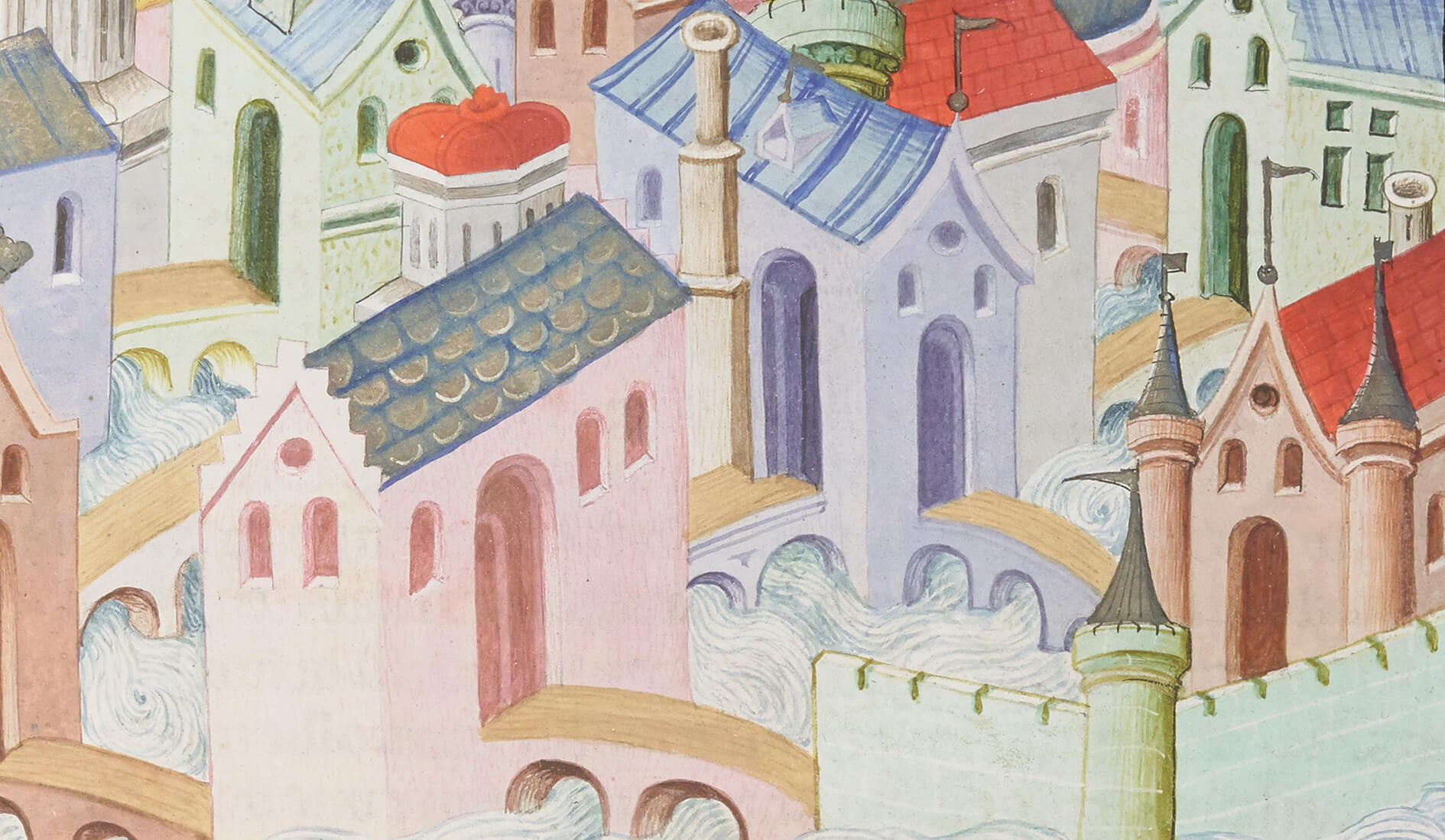
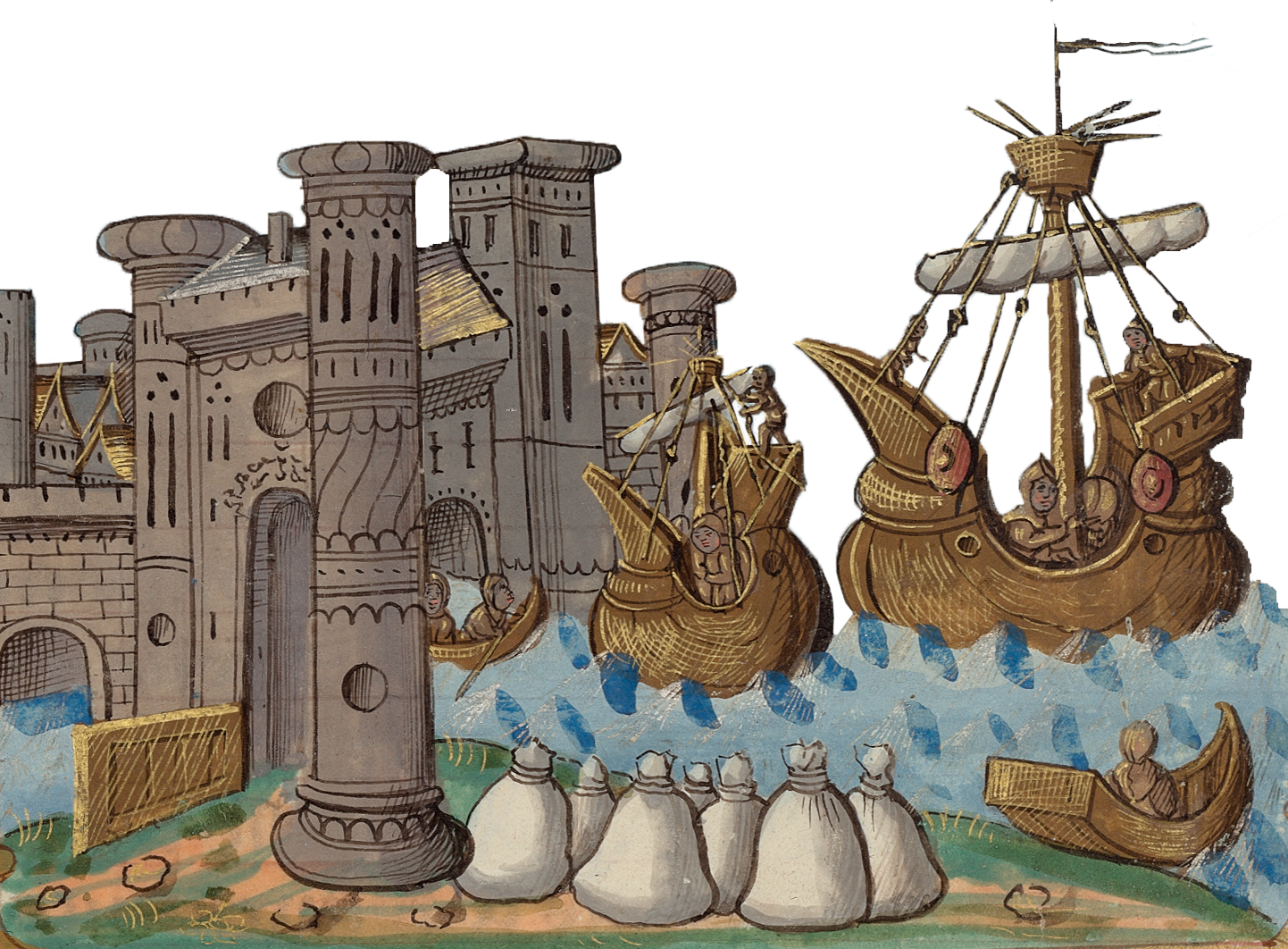
•Quinsai (Hangzhou), ca. 1410. Paris, Bibliothèque nationale de France, fr. 2810, f. 67r
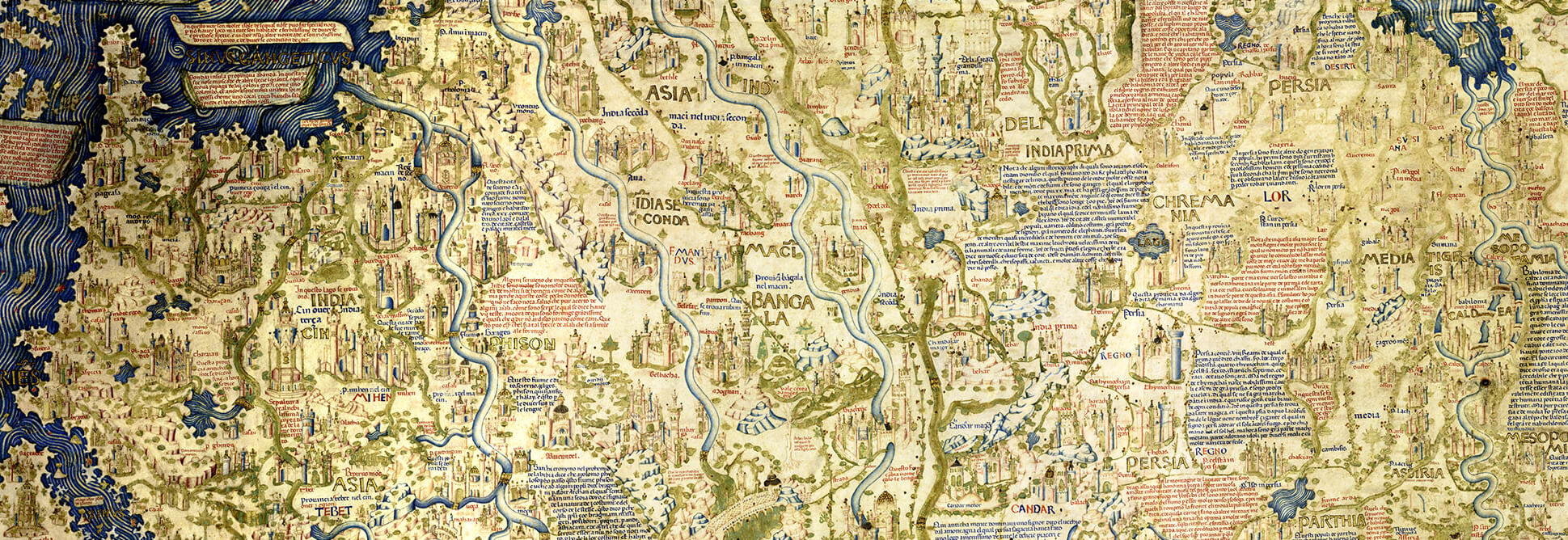
•Il Mappamondo di Fra Mauro, ca. 1450. Digital reconstruction created by Andree Hansen Wibowo under the supervision of Davide Benvenuti (NTU Singapore), based on 36 files provided by the Biblioteca Nazionale Marciana in 2019.
© Biblioteca Nazionale Marciana
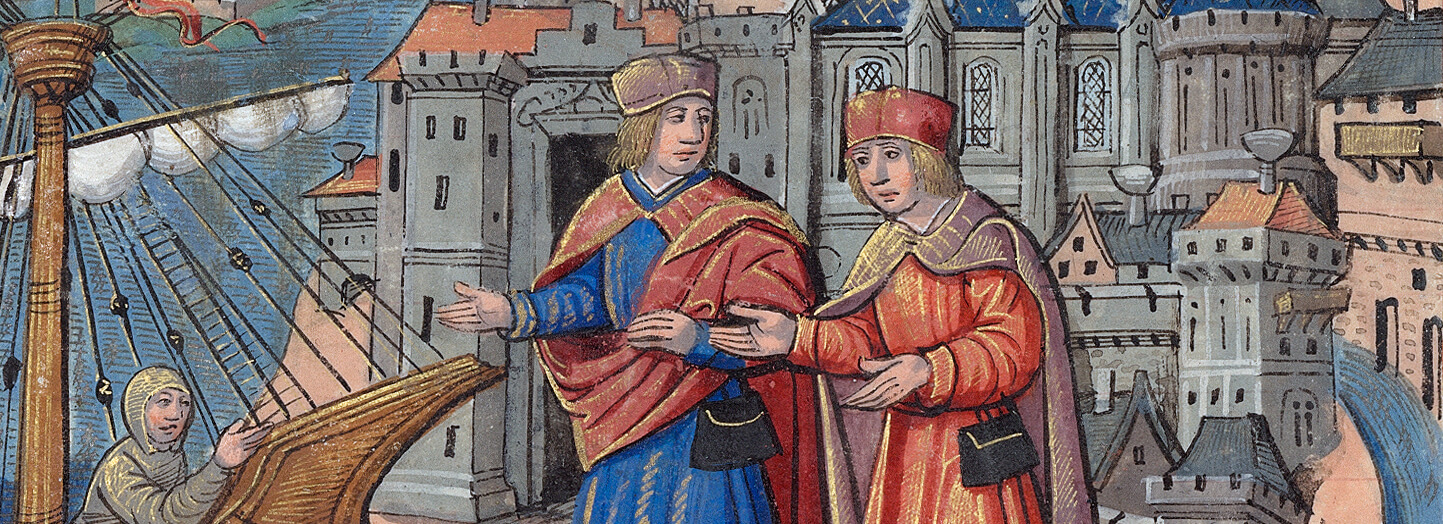
•Venezia. Early 1500s. Paris, Bibliothèque de l’Arsenal, 5219, f. 9r
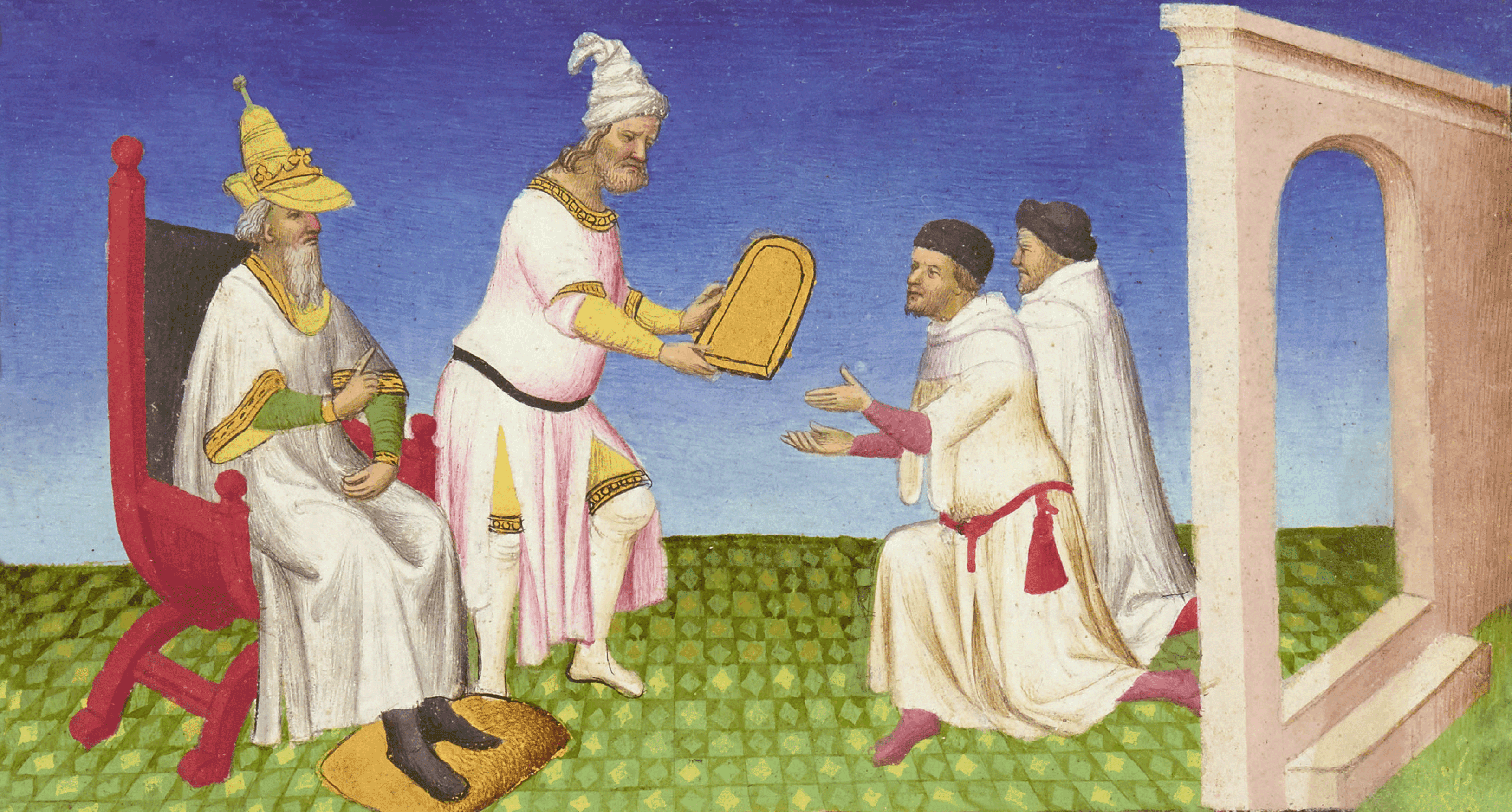
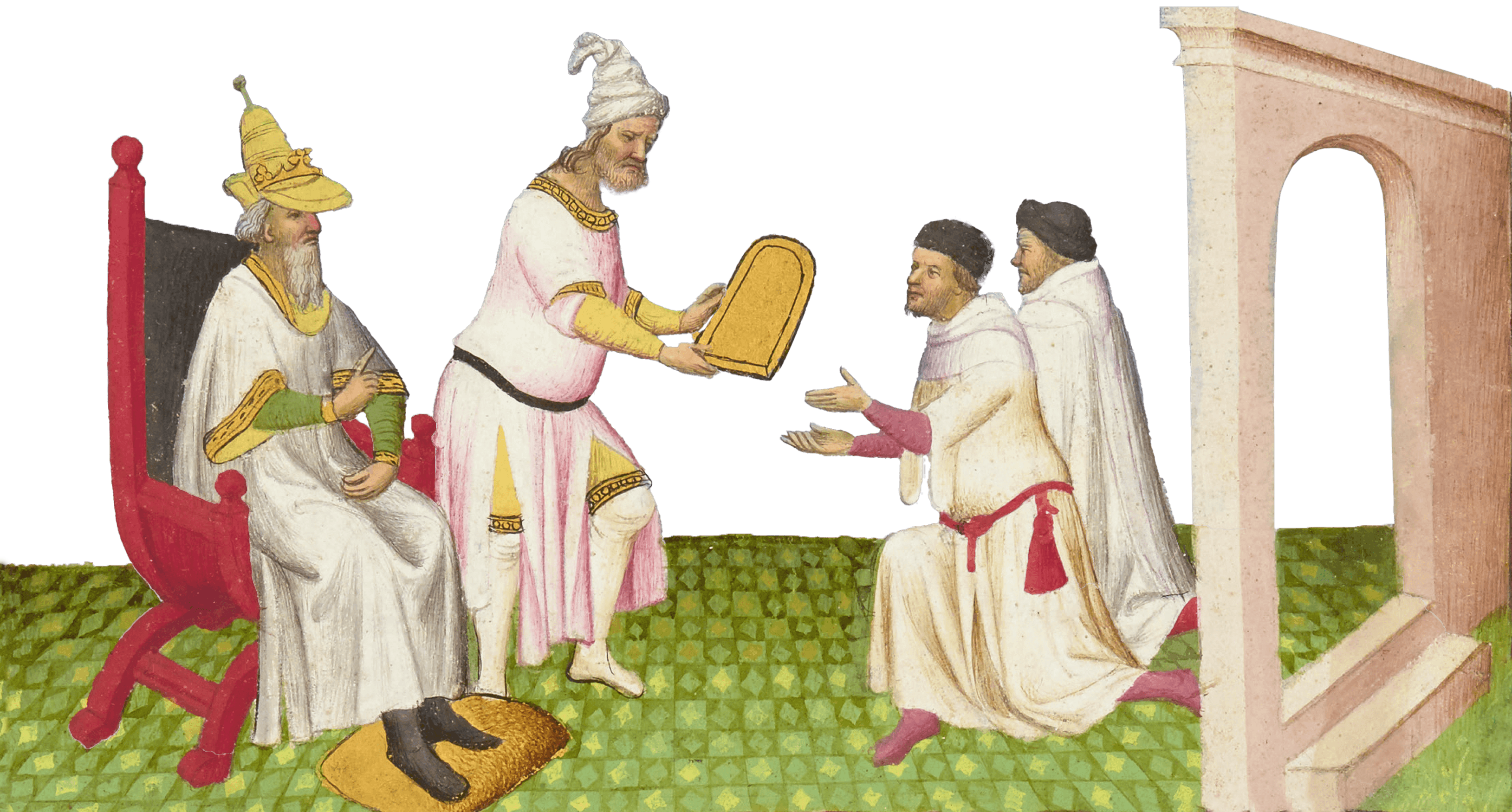
•L’incontro con il Gran Khan, ca. 1410. Bibliothèque nationale de France, fr. 2810, f. 3v
•Singiumatu (Xinzhou matou/Jining, Shandong). Paris, Bibliothèque de l’Arsenal, 5219, f. 103r