Marco Polo Studies in Global Europe-Asia Connections
open access | peer reviewed
Aims & Scope
The book series, sponsored by the Department of Asian and North African Studies through the Marco Polo Research Centre for Global Europe-Asia Connections, is designed to publish up-to-date research that is supported by the Centre. In dialogue with the intellectual tradition of the Centre, our research interests are vast, spanning manifold spaces (from Japan to the Mediterranean Sea), times (from Neolithic times to today, and possibly the future), and themes (from modern geopolitics to religious identities to climate change to archaeological sites), with particular attention to trans-Eurasian interactions. This emphasis on intercultural contact and exchange, especially at the crossroads of the ostensible European-Asian divide, is evoked through the title of the series: indeed, Marco Polo travelled all the way from Venice to Beijing at the end of the 13th century, engaging with many different political contexts, nations, and civilisations along the land and sea routes later jointly known as the Silk Road (or, better, Silk Roads). This concept, with its underlying reference to the exchange of things and ideas across societies, is a historical phenomenon of great significance associated with a distant past; however, the spectre of the Silk Road(s) has never rested. The People’s Republic of China announced the ‘Silk Road Economic Belt’ (now known as the ‘Belt and Road Initiative’) in 2013. In other words, the distant historical traditions of the Silk Road(s) continue to penetrate discursive reality in our own day and age. Globalisation – with its various and contradictory connotations – is an overarching motif that links the Silk Roads of the past and the present. Inspired by the famous Venetian merchant, our book series prioritises studies that are inquisitive, bold, and dynamic, with a preference for transcultural and interdisciplinary studies. We welcome manuscripts that are grounded in rigorous scholarship and speak to international academic conversations within and across diverse disciplines, including history, international relations, economics, environmental studies, literature, languages, archaeology, art history, philosophy, religion, anthropology, geography, music, social sciences, and the digital humanities. The books in this series will focus on specific research topics but will range from single-authored monographs to edited volumes with multiple authors, each contributing a chapter to an organically conceived whole.
Permalink doi.org | e-ISSN 2785-5627 | ISSN 2785-5899 | Language ar, en, it | ANCE E266404
Copyright This is an open-access work distributed under the terms of the Creative Commons Attribution License (CC BY). The use, distribution or reproduction is permitted, provided that the original author(s) and the copyright owner(s) are credited and that the original publication is cited, in accordance with accepted academic practice. The license allows for commercial use. No use, distribution or reproduction is permitted which does not comply with these terms.
Latest published volume
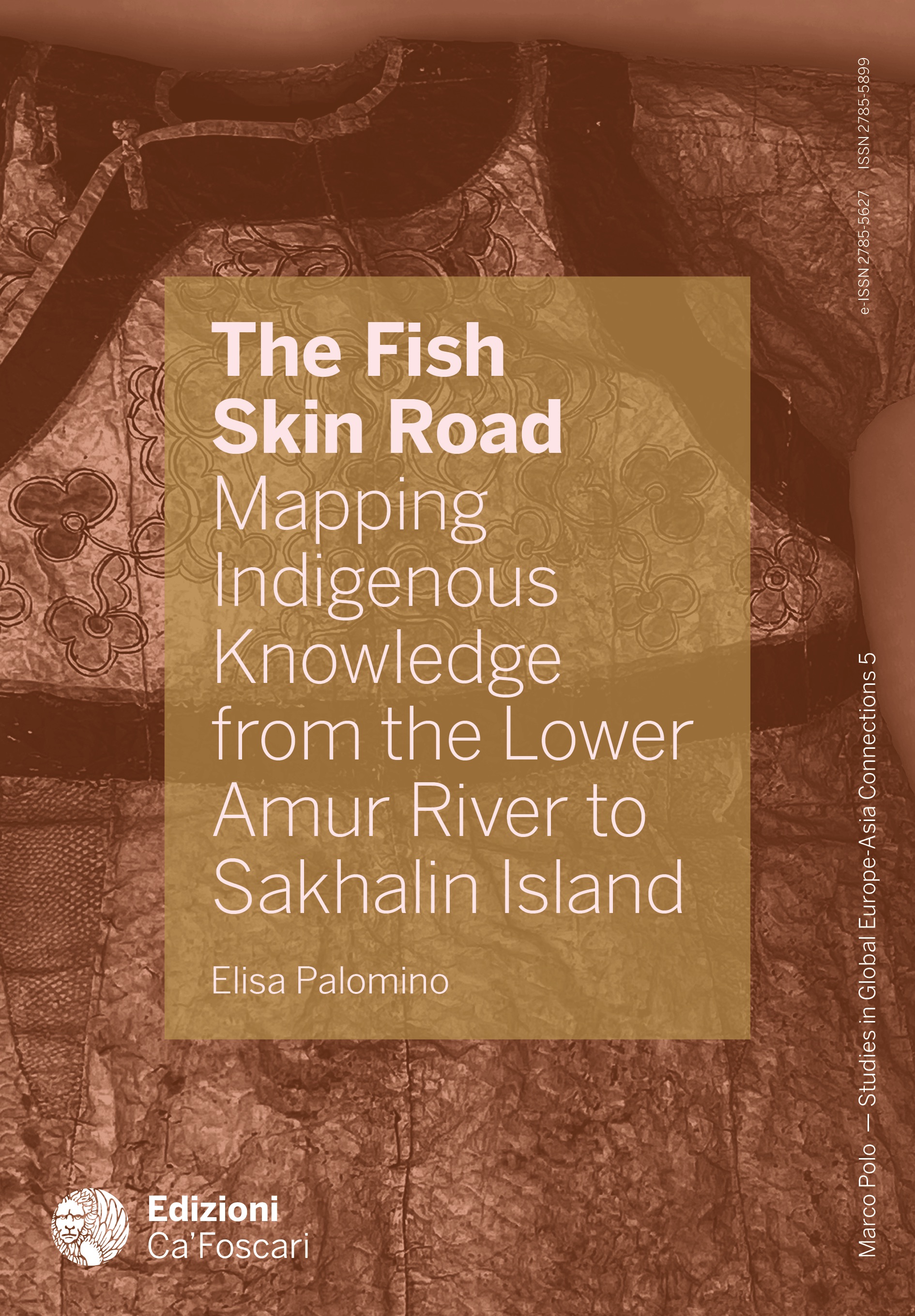
- The Fish Skin Road
- Mapping Indigenous Knowledge from the Lower Amur River to Sakhalin Island
- Sept. 9, 2026
- This book traces the historical circulation of fish skin garments, accessories and traditional production methods among Indigenous communities of the Lower Amur River, Hokkaido and Sakhalin Island, including the Nivkh, Nanai, Hezhe and Ainu. Over centuries, trade, travel and salmon-based subsistence economies enabled the transmission of tanning, dyeing and sewing practices across the region. Although colonisation divided Native territories along Russian, Chinese and Japanese borders and restricted access to resources, seasonal harvesting cycles and fish skin technologies persisted. Fish skin garments held in museum collections preserve knowledge of environmental adaptation, gendered labour and material expertise. These Native belongings document enduring relationships between people, fish and landscape. Recognition of their technical, social and ceremonial roles highlights the expertise of Indigenous women artists and the knowledge transmitted through their work. These garments stand as masterpieces of Native art, affirming the place of Arctic Indigenous women within art history and the history of fashion.
- 239 download 1169 search
- Obiettivo seta | Reframing Silk
- Feb. 2, 2026
- 242 download 1253 search
- People and Plants in Ancient Southwest China
- Sept. 18, 2025
- 231 download 1105 search
- Connecting Water
- March 19, 2024
- 1347 download 3214 search
- Stoneyards and Artists in Gandhara
- April 14, 2022